Yinaar
STATUS
Program
YeAR oF dELIVERY
Project Information
Description
Yinaar
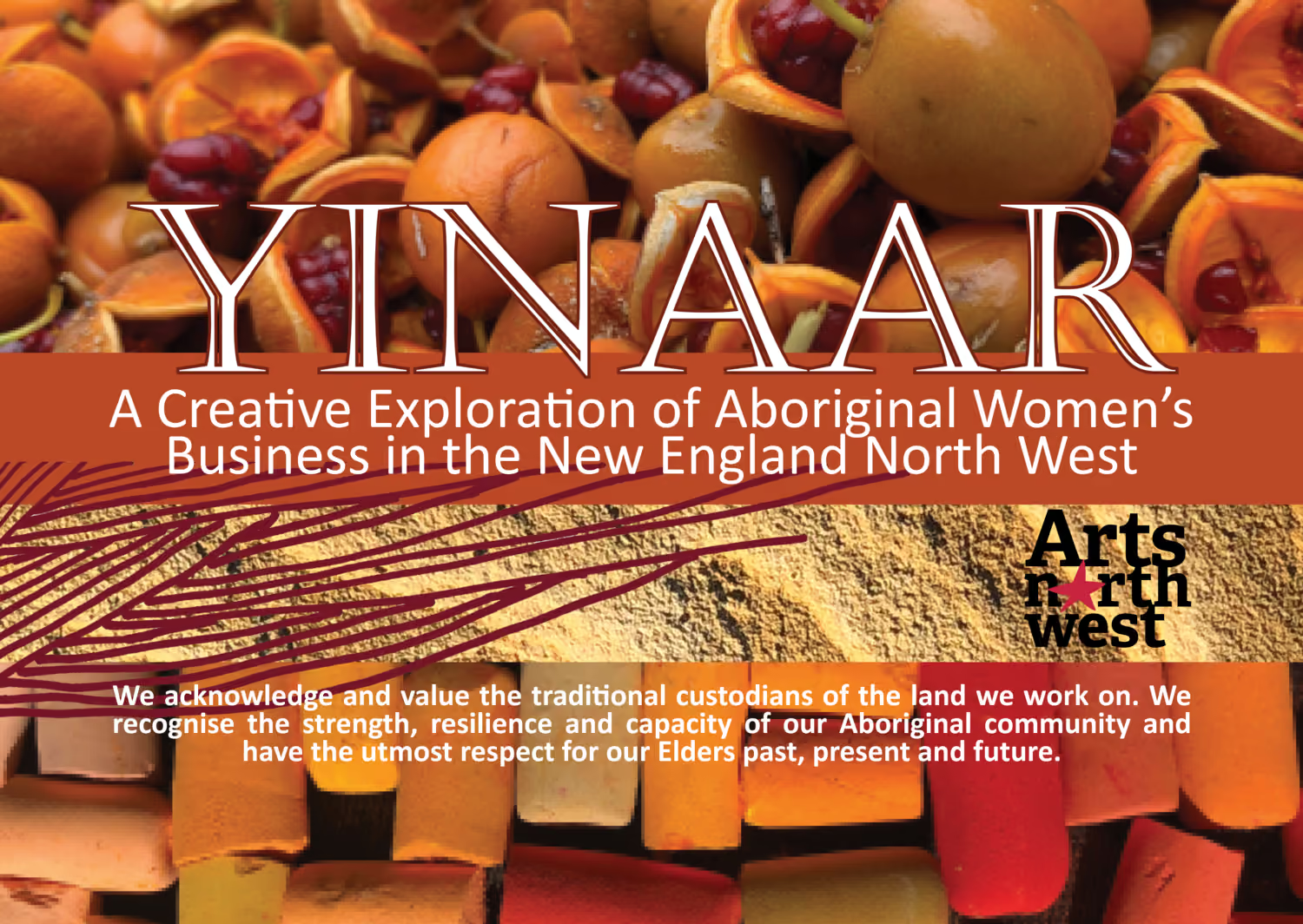
A creative exploration of Aboriginal women's business in the New England North West
The YINAAR project required extensive consultation with Aboriginal women in the New England North West region, supported by the guidance and protocols developed in partnership with Elders and Knowledge Holders. This project achieved significant milestones, reflecting the community's aspirations while maintaining cultural sensitivity.
Elders, Knowledge Holders, and community members across the region's 12 Local Government Areas were engaged through consultation sessions and one-on-one meetings. These consultations endorsed whole-community cultural protocols, ensuring the project's alignment with the community's cultural values and aspirations. This collaborative approach established a strong foundation of trust and respect among participants.
The project was led entirely by Aboriginal women and overseen by a steering committee comprising representatives from across the region. The committee served as a critical link between Arts North West, the project team, and the community, ensuring transparent communication and adherence to cultural protocols.
In its research phase, the project drew on key resources, including Terri Janke's Pathways and Protocols and the AIATSIS Guidelines for Ethical Research in Australian Indigenous Studies. Research activities were conducted on Country, in communities with strong Women’s Business practices, and through archival resources such as the Australian Museum, NSW State Library, and Dhiiyaan Unit Moree. Oral histories and multimedia documentation enriched the project's narrative and served as tools for preserving and sharing knowledge.
The project focused on elements such as Gali (water lore), food and medicine, kinship structures, healing practices, and language preservation. These themes were explored through oral histories, collaborative research, and storytelling, culminating in the creation of a series of short documentaries and case studies. While certain sensitive aspects, like Women’s Initiation Practices, were kept private, they contributed to the depth of the project's cultural exploration.
The creative outcomes included a body of work developed by Aboriginal artists from the region. These artists, guided by Elders and mentors, participated in residencies and workshops that strengthened their skills and connection to traditional knowledge. The project facilitated cultural identity building and capacity development for regional artists, fostering a unique blend of traditional and contemporary artistic practices.
The final artworks and narratives were presented through curated exhibitions at regional galleries, offering the community an opportunity to engage with the artists' journeys and stories. These exhibitions celebrated the project's success in preserving and transmitting cultural heritage while empowering Aboriginal women to share their knowledge and creativity.
THE AIM
“To deliver contemporary artistic and creative practice inspired by Aboriginal women’s traditional practices from the New England North West of NSW”
THE PROJECT SCOPE:
Stage 1 – Informed Consultation
This project is 100% Aboriginal led and will be delivered by Aboriginal women. A steering committee for the project was established with Aboriginal women from throughout the region. Their role was to act as a conduit between the Arts North West, the project team and the community. Throughout the whole project Elders and Knowledge Holders were engaged to provide cultural guidance and ensure that protocols were respected.
Stage 2 – Research & Creative Development
ANW YINAAR cultural protocols were based on two key documents: Terri Janke, Pathways and Protocols: A filmmaker’s guide to working with Indigenous people, culture and concept (2008) and AIATSIS Guidelines for Ethical Research in Australian Indigenous Studies (2012). These provided the principles that will guide the Yinaar project research.
Research was undertaken both on Country and through visits to other communities who continued to have strong ‘Women’s Business” practices in place as well as desktop research and exploring current resources. Research was also undertaken, exploring resources such as the Australian Museum, NSW State Library, AIATSIS and the Dhiiyaan Unit Moree as well as other reliable resources we were able to obtain.
The research was undertaken by the Aboriginal Project Management team with a strong focus on oral history. The team documented the research in written and multi-media format and were accompanied by an Elder who provided cultural guidance throughout the research process.
Songlines and storytelling informed YINAAR. Knowledge Holders who have been identified by the community, and additional Knowledge Holders were engaged as the project evolved.
The key elements of focus:
- Gali: Aboriginal women hold the lore of water, and they have a deep spiritual and cultural connection to the land, the sky and the rivers.
- Food & Medicine: Type of and use of native plants, fruits and seeds including how they were/are protected, propagated, harvested and prepared.
- Kinship & Responsibilities: The structure of Aboriginal families including cultural values and involving kinship responsibilities and the collaboration of clans.
- Healing: Women’s traditional healing practices and how they have been adapted into a contemporary society.
- Language: Use of language by Aboriginal women in a traditional and contemporary context and the importance of preserving language.
These key elements were also captured in a series of short documentaries, filmed as part of the research process.
Additionally, community asked for the project to include Women’s Initiation Practices – Women taking responsibility for themselves and each other, rites of passage into womanhood and the responsibilities that this creates. However, as this is sensitive information, the research will only be viewed by the artists, steering committee and project team and will not be published for the general public.
All completed research was presented back to the steering committee and Elders for final sign off before publishing.
Stage 3 – Creative Outcomes
YINAAR supports the transmission and development of Aboriginal cultural heritage and knowledge using the arts as the vehicle to drive the sharing, documenting and preserving of culture.
The creative component connected artists through engagement and participation in a culturally based project that broadened and deepened their understanding of Women’s Business.
Experienced Aboriginal artists were engaged through an EOI process who are Yinaar from the New England North West. This project was developed to provide skill development to build capacity for Aboriginal artists in our region and to strengthen cultural identity in our region.
Supported by Elders, project management team, steering committee and an Aboriginal curator, the artists developed a body of work that responds to the elements of the creative development stages. The artists have had valuable opportunity to connect and rebuild traditional knowledge and to develop their own unique style for use in their contemporary practice. The artists shared their experiences to community through the artworks produced and the stories recorded as well as artist talks at the exhibitions in the region.
The artists participated in the following:
- 3-day residency to discuss the findings from the creative development stage, share art making practices and map their body of works.
- 3-day art making workshop exploring new and innovative creative practices responding to the findings from the creative development stage.
- Mentoring from Elders, project management team and curator.
- Curated exhibitions at two regional galleries in the New England North West.
Due to the sensitivity of the project we will include the following:
- Specific project steering committee.
- 100% Aboriginal Women’s project including artist and project team.
- Specific protocols around who would have access to the oral history, how it is displayed and used, who would be the caretaker of the information at the completion of the project.
- Guiding Principles and ANW Yinaar Cultural Protocols can be downloaded below.
Some of the frequently asked questions we receive include:
Q. Are Elders, Knowledge Holders and artists paid?
A. Yes, all of the Elders and Knowledge Holders who participate in the project are paid.
Q. How do we select the Elders, Knowledge Holders and artists?
A. Through the consultation stage of the project we ask the community to share suggestions on who they would like to participate. We also use our network to share the project and ask for them to express interest if they would like to be involved.
Q. What Cultural Protocols are in place?
A. To ensure the integrity, inclusiveness and transparency of the project we have a comprehensive cultural protocols document that will guide us, this document is currently on our website for feedback, to view the cultural protocols and provide feedback please “click here”. In summary we will work within a set of guiding principles that will ensure we are accountable not only to the funding body but more importantly the community. Aboriginal community members are at the forefront of this project and it is important that their voice is truly heard and listened to at all levels of the project.
INTRODUCTION
Arts North West support the rights of Aboriginal and Torres Strait Islander people and communities to celebrate and practise their cultures, to fulfil creative aspiration and govern their cultural material and stories associated with cultural objects and cultural knowledge. Furthermore, we recognise and respect that Aboriginal people have a right to self-determination, particularly in respect to cultural matters. This includes making decisions about preserving and sharing their traditional and contemporary cultural knowledge and practices.
YINAAR STEERING COMMITTEE
Arts North West are fostering self-determination and empowerment by establishing a 100% Aboriginal Steering Committee to lead and drive the direction of the “Yinaar” Project, specifically around cultural guidance, decision making, strategic planning, advice and feedback. The Steering Committee is committed to achieving the aspirations of the community and will be dedicated to developing respectful and sustainable relationships based on trust and respect for our cultural values and our histories.
PURPOSE
These protocols have been established in consultation with the partners in the project and with contributions and approval from the Steering Committee as led by the Lead Elder to ensure that the “Yinaar” project respects the cultural beliefs and practices of Aboriginal women from the project footprint.
Arts North West, in instigating these protocols and project are committed to pursuing genuine recognition of the truth of Australia’s colonisation and history. Aboriginal people are the traditional custodians of the land, the stories and the practices and we recognise and respect this through ensuring cultural protocols are acknowledged and adhered to for the “Yinaar” Project and the wider operations of Arts North West.
Article 31 of the United Nations Declaration on the Rights of Indigenous People, which Australia has endorsed, affirms that:
Indigenous peoples have the right to maintain, control, protect and develop their cultural heritage, traditional knowledge and traditional cultural expressions, as well as the manifestations of their sciences, technologies and cultures, including human and genetic resources, seeds, medicines, knowledge of the properties of fauna and flora, oral traditions, literatures, designs, sports and traditional games and visual and performing arts. They also have the right to maintain, control, protect and develop their intellectual property over such cultural heritage, traditional knowledge, and traditional cultural expressions.
What are Cultural Protocols?
Protocols refer to the value systems, customs and cultural practices that are important to identify a particular cultural group. Protocols are an important part of all cultures and provide guidance on how to treat and work with people in a respectful and useful way. Observing protocols demonstrates respect for cultural continuum, knowledge systems and diverse practices. With over 65,000 years of unbroken, continuous cultural lineage, Aboriginal and Torres Strait Islander cultures are diverse, complex and resilient.
Cultural Protocols are ethical principles which guide behaviour and actions, these protocols are designed to protect cultural and intellectual property rights and are aimed at improving working relationships between Arts North West and the Aboriginal community allowing us to deliver better outcomes for the community.
These protocols are based on two key documents: Terri Janke, Pathways and Protocols: A filmmaker’s guide to working with Indigenous people, culture and concept (2008) and AIATSIS Guidelines for Ethical Research in Australian Indigenous Studies (2012) These provide the principles that will guide the Yinaar project.
Cultural Protocols and intellectual property rights include the rights of Aboriginal people to:
• Own and control their cultural and intellectual property
• Ensure that any means of protecting their cultural and intellectual property is based on the principle of self-determination
• Be recognised as the primary guardians and interpreters of their cultures and so regulate how stories and information is presented
• Authorise or refuse the use of their cultural and intellectual property according to customary law
• Maintain the secrecy of the knowledge and other cultural practices
• Be given full and proper attribution for sharing their heritage
• Control the recording of cultural customs and expressions, the particular language which may be intrinsic to cultural identity, knowledge, skill and teaching of culture.
GUIDING PRINCIPLES
To ensure the integrity, inclusiveness and transparency of the project we will work within a set of guiding principles that will ensure we are accountable not only to the funding body but more importantly the community.
Aboriginal community members are at the forefront of this project and it is important that their voice is truly heard and listened to at all levels of the project.
The guiding principles are:
1. The voice of Aboriginal people is our primary source of information;
2. Non-Aboriginal people are also involved in the project, we recognise they also have value to add to the process but they must respect that the voice of the Aboriginal community must come first;
3. We recognise that there may not be a single method of consultation that is best suited to the Aboriginal community and as such we offer a flexible approach that encourages inclusiveness and is open to ideas.
4. We recognise the importance of, and commit to holding the utmost respect for cultural protocols, this includes flexibility for ‘sorry business’ and other culturally sensitive events;
5. This is a voluntary process for all people involved, although we hope for collaborative involvement, we respect the right of any person or organisation not to participate;
6. Aboriginal people may want to have their voice heard but they may wish to do so privately, we will always ask permission before publishing their contribution, knowledge thoughts, ideas and strategies;
7. We will accurately record the whole of project process including consultation and feedback, and commit to ensure approval is received before individual quotes are published;
8. Aboriginal people and communities who participate will be attributed in all publications, resources and films except where they have provided a written request to have their details suppressed.
9. Elders, Knowledge Holders and Artists will be paid for their contribution and knowledge transfer in the project.
COMMUNICATION, CONSULTATION AND CONSENT
Consultation refers to the process whereby people exchange views and information. Consultation is not just a one-way process, but a process of sharing knowledge and opinions. Consultation means working together, listening to what the other party has to say and acting upon it.
Consent is a process whereby permission is given, based on a relationship of trust.
Community engagement, conversations and our strong relationship with the Aboriginal community originally identified the need to deliver a project that specifically addresses Women’s Business in our region. Our community have told us they have a strong desire to hear and learn the cultural history and stories from our region which is vital to achieving strong cultural identity. The intersection of story-telling, Songlines and contemporary creative practice will drive the outcomes of this project.
This project will require a significant amount of consultation with Aboriginal women in the region, strong protocols specific for such a sensitive project and the support of Elders in the community. Elders, Community Members and Knowledge Holders from each of the 12 LGAs that make up the Arts North West region will be consulted through a series of consultation sessions, meetings and conversation.
This consultation will allow for whole of community cultural protocols to be tabled and implemented and will ensure that the work we do continues to be in line with the aspirations of the community while holding the utmost cultural respect.
Arts North West respect that the process of consultation is fundamental to delivering a project, especially publishing through film and other media, with Aboriginal peoples. Arts North West believe that the depth of the consultation process will be reflected in the quality of the final outcomes. Furthermore, we recognise that consultation alone isn’t enough, and that projects require written, or documented forms of consent and support.
Rules and principles that we will follow include but are not limited to:
- Informed consultation requires a multi-level approach, and cannot be a one-off consultation or engagement, relationships need to be built on trust and maintained over time;
- Don’t rush consultation – allocating more time will help you gain a better understanding of the richness of our culture;
- Understand and appreciate where the Aboriginal community is coming from:
- Be aware of cultural differences and expectations,
- Show courtesy and respect in the way you approach people,
- Be respectful of time limitations,
- Avoid bureaucratic jargon and acronyms,
- Be aware that Aboriginal people may have a different perspective to what you have, and
- Be mindful that one Aboriginal person or even one group of Aboriginal people are not representative of the whole community.
- The team need to immerse themselves in the community to build connections, relationships, respect and partnerships.
Free and Informed Prior Consent
Free and Informed Prior Consent is a specific right that pertains to Aboriginal peoples and is recognised in the United Nations Declaration on the Rights of Indigenous Peoples (UNDRIP). It allows them to give or withhold consent to a project that may affect them or their territories. Once they have given their consent, they can withdraw it at any stage. Furthermore, it enables them to negotiate the conditions under which the project will be designed, implemented, monitored and evaluated. This is also embedded within the universal right to self-determination.
Free: consent given voluntarily and without coercion, intimidation or manipulation. A process that is self-directed by the community from whom consent is being sought, unencumbered by coercion, expectations or timelines that are externally imposed.
Informed: nature of the engagement and type of information that should be provided prior to seeking consent and also as part of the ongoing consent process
Prior: consent is sought sufficiently in advance of any authorization or commencement of activities.
Consent: collective decision made by the right holders and reached through a customary decision-making process of the communities.
RIGHTS, RESPECT AND RECOGNITION
Respectful use of cultural material and information about life experience is a basic principle.
The Aboriginal and Torres Strait Islander people, are the original inhabitants of Australia. As such they have a strong link to country, meaning the totality of life and the spirit of the particular area of land they and their ancestors inhabited.
In traditional practice, a group of Aboriginal people who wished to travel through Country that was not their own camped at the edge of the Country and awaited a welcoming party. The protocol allowed the visiting people to acknowledge the Traditional Custodians and seek permission to enter or use resources from the land and sea. The Traditional Owners in turn would welcome the visiting people, grant permission to enter their land, and grant protection from spirits who otherwise could cause difficulties for the visiting tribe according to Aboriginal spiritual beliefs.
In contemporary society, this traditional practice is honoured through a Welcome to Country or Acknowledgement of Country which is performed at the opening of a public event, ceremony or meeting. A Welcome to Country is performed by an Elder who is a member of the traditional custodians of the land on which the event is being held. There is no particular script for a Welcome to Country and how it is performed depends on the individual. Elders performing a Welcome to Country should always be seated with other dignitaries
and speakers at the event.
Welcome to Country
A Welcome to Country should be performed by an Elder. Elders are people within the Aboriginal community who have earned that title and have knowledge of the
local heritage and culture.
Consultation should occur with the Local Aboriginal Land Council to seek a list of appropriate people who can perform a Welcome to Country. It is expected that Elders are paid for conducting a Welcome to Country.
For any major event (such as exhibition opening), all efforts should be made to arrange for an Elder to perform a Welcome to Country. If enough people are available, and particularly for a very large or significant event, it may be preferable for a male and female Elder to perform the Welcome together.
Acknowledgement of Country
At smaller events, such as regular meetings, an Acknowledgement of Country is often acceptable.
An Acknowledgement to Country is a way that non-Aboriginal people and Aboriginal people from other nation groups show respect for the traditional custodians.
An Acknowledgement to Country should be performed by the main dignitary or chair of the event and is always the first point of business at any meeting or gathering. There is no “correct” wording for an Acknowledgement of Country, but as a general guide the following may be used:
I would like to acknowledge that we meet today on the traditional lands of the Kamilaroi/Gamilaroi/Gomeroi people. I recognise their continuing connection to this land and pay my respects to Elders past and present and I extend that respect to any Aboriginal people present here today.
Accepting Diversity
Aboriginal culture is diverse. Culture varies depending on country (area of land within Australia) and particular language groups. Aboriginal artists come from many different backgrounds, learn their art in many different ways, and develop their media works in many different styles.
Recognition of the diversity and uniqueness of peoples, as well as of individuals, is essential, we must recognise the diversity of Aboriginal people, including their different languages, cultures, histories and perspectives. It is also important to recognise the diversity of individuals and groups within communities.
Representation
Representation refers to how cultural material is interpreted and represented. In film making and project development, the representation of Aboriginal people on film has been manifest in the use of words, language, story, plot and cultural symbols.
It is important that it is acknowledged where material has originated and that the cultural source is authentic. Giving proper consideration to authenticity means respecting customary laws or cultural obligations and ensuring that the appropriate context is given to the cultural material. To take cultural heritage material out of context or use it inappropriately can displace the cultural authenticity of a film.
Aboriginal people and their cultures need to be represented in a manner preferred by those cultures. Inappropriate or outdated perspectives and terminology should be avoided. It is important to consult the relevant groups about this. The project team will represent Aboriginal people in appropriate ways that are not stereotypical nor offensive and demeaning. Wrongful and hurtful portrayals can cause divisions in communities.
Living Cultures
Aboriginal Cultures are living and evolving entities – not historical phenomena. Aboriginal artists draw upon their pre-existing cultural base in many different ways. It is important to respect the diversity of cultural expression in Aboriginal art, and acknowledge its ongoing development through different styles and forms.
Furthermore it is important the language used fits the story; that it is of the people and community represented. Certain words used in one area or by one community can mean something totally different in another community.
Rights to Self Determination
The rights of Aboriginal people to self determination must be recognised. Projects must be conducted in accordance with the United Nations Declaration on the Rights of Indigenous peoples, including principles of Indigenous peoples’ rights to self determination and to full participation (appropriate to their skills and experience) in developments that impact
on their lives.
Rights to Intangible Heritage
The rights of Aboriginal peoples to their intangible heritage must be recognised. Projects and activities must be conducted in accordance with the principle of Aboriginal peoples’ rights to maintain, control, protect and develop their intangible heritage, including their cultural heritage, traditional knowledge, traditional cultural expressions and intellectual property.
Traditional Knowledge, Practices, Innovation and Cultural Expression
The rights of the traditional knowledge and traditional cultural expressions of Aboriginal people must be respected, protected and maintained. Traditional knowledge and traditional cultural expressions are part of the heritage that exists in the cultural practices, resources and knowledge systems of Aboriginal peoples, and that are passed on by them in expressing their cultural identity.
To respect, protect and maintain these rights, the project team must have a good understanding of the nature of Aboriginal traditional knowledge systems, traditional cultural expressions and intellectual property. Acknowledging and respecting Aboriginal knowledge, practices and innovations is not only a matter of courtesy but also recognition that such knowledge can make a significant contribution to the research process.
Once Aboriginal knowledge is recorded, it becomes ‘property’ as defined under Western laws and concepts. It is therefore essential that the rights and interests of Aboriginal people, whose knowledge it is, are recognised and protected throughout the project, and in regard to research products and outcomes after the life of the project.
PARTICIPATION, COLLABORATION AND PARTNERSHIP
Aboriginal people have the right to full participation appropriate to their skills and experiences in projects and activities. Projects and Activities should be based on an awareness of the rights of Aboriginal peoples to full participation in decision making in matters that affect their rights.
Research on Aboriginal issues should incorporate Aboriginal perspectives. This is often most effectively achieved by facilitating direct involvement in the research from the
start of a project.
If a participant withdraws, then he or she should agree what should be done with the contributions made to the research project up to the date of the withdrawal.
This is a voluntary process for all people involved, although we hope for collaborative involvement, we respect the right of any person or organisation not to participate.
Aboriginal people may want to have their voice heard but they may wish to do so privately, we will always ask permission before publishing their contribution, knowledge thoughts, ideas and strategies. We will accurately record the whole of project process including consultation and feedback, and commit to ensure approval is received before individual quotes are published.
Aboriginal people and communities who participate will be attributed in all publications, resources and films except where they have provided a written request to have their details suppressed.
BENEFITS, OUTCOMES AND GIVING BACK
Communities and people involved in the project, or who may be affected by the project, should benefit from, and not be disadvantaged by the project. Aboriginal specific programs and activities should benefit Aboriginal peoples at a local level, and more generally, communities and people who contribute traditional knowledge, practices and innovations, cultural expressions and intellectual property, skills, know-how, cultural products and expressions, and biological and genetic resources should receive fair and equal benefits.
A reciprocal benefit should accrue for allowing researcher’s access (often intimate) to personal and community knowledge.
Elders, Artists and Knowledge Holders will all be paid for their contribution to the project, the negotiation of this payment including payment schedules and amounts will be detailed in a service level agreement prior to any person sharing their knowledge.
References
1. AIATSIS, Guidelines for Ethical Research in Australian Indigenous Studies, 2012
2. Australia Council for the Arts, Protocols for Working with Indigenous Artists
3. Janke, Terri, Pathways and Protocols: A filmmaker’s guide to working with Indigenous people, culture and concepts,Screen Australia, 2008.
4. Oxfam Australia, Aboriginal and Torres Strait Islander Cultural Protocols
_5. _Tamworth Local Aboriginal Land Council – Community Protocols Guidelines
6. United Nations Declaration on the Rights of Indigenous Peoples

This project has been assisted by the Australian Government through the Australia Council, its arts funding and advisory body.

Guiding Principles and ANW Yinaar Cultural Protocols can be downloaded here
Creatives


Venues
Public Art
Local Government Partners



.png)


.avif)
All things arts and culture — receive the latest news, events, workshops and other opportunities sent directly to your inbox